AI Agent Development
Part of Operations Automation
AI that does the work, not just talks about it.









What is an AI agent?
An AI agent is software that handles a task and the decisions inside it, not just a single fixed step. A basic automation follows a set path: when X happens, do Y. An agent can take a messier job: read an email, work out what it’s actually about, pull the details it needs from your systems, take the right action, and escalate anything it isn’t sure about. It’s built on standard models, wired into the tools you already use through their APIs, and run on infrastructure you own. The useful ones work in the background, taking a whole slice of repetitive, judgement-heavy work off your team while keeping a person on the parts that need one. It’s one of the automation services we build.
Why an agent instead of a plain automation?
Most real work isn’t a straight line. The tasks that eat a team’s day (answering support, qualifying leads, processing documents, chasing what’s outstanding) are full of small judgement calls. A rigid automation breaks the moment something doesn’t fit its one path, and a person ends up handling the exceptions, which is most of them.
An agent copes with the variation. It reads the situation, decides the next step, and only pulls in a person when it hits something actually uncertain or high-stakes, which turns out to be a fraction of the volume, not all of it.
Your people stop doing the repetitive nine-tenths and get their hours back for the tenth that needs them. The work still gets done, the same way every time.
Most of this isn’t an agent.
Before anything else, the honest bit. A lot of what gets sold as an AI agent is a rules-based workflow with a language model somewhere in it, and that’s often the right answer. Agents earn their keep when the input is messy and the decision really does vary. Where the rules fit on a page, we build the rules and charge less.
Why build it with Better Automations?
What does success look like?
A month in, a whole category of work handles itself. The support queue clears because routine tickets are read, actioned and answered before anyone opens the inbox. Leads are qualified and routed while they’re still warm, and documents are processed and filed without anyone re-keying them. Your team spends its day on the calls that need a person, with an agent doing the repetitive lifting underneath and flagging anything out of the ordinary. Nothing high-stakes runs unwatched, and everything it does is logged.
AI agent FAQs
It’s software that handles a task and the decisions inside it, not just a single step. Where a basic automation follows a fixed path, an agent can read a message, work out what it’s about, look up what it needs, take the right action, and hand off to a person when it’s out of its depth. A script can’t handle "it depends". An agent can.
A chatbot answers. An agent does. A support chatbot might tell a customer how to request a refund. A support agent reads the email, checks the order in your system, applies your policy, issues or escalates the refund, files the record, then drafts the reply. The conversation is the smallest part of that. Most useful agents run in the background and never chat to anyone.
The best fits are high-volume tasks with a lot of small judgements: triaging and answering support, qualifying and routing inbound leads, processing documents and invoices, chasing outstanding items, keeping records across systems in sync. If a capable person spends their day making the same kind of call over and over, that’s a candidate.
Any software makes mistakes, so we build agents with the guardrails on. They work inside defined limits, hand anything uncertain or high-stakes to a person, and log what they do so you can check it. You decide which steps an agent can finish on its own and which always need a person. We’re removing the grind, never the judgement.
No. Agents are built on standard models and run on infrastructure you own or control, connected to the tools you already use through their APIs. There’s no data centre to buy. You get a system wired into your stack, with the accounts and data in your name.
We start with one process, scope it to a fixed price, and prove it on your real data with a person watching before it runs on its own. You see it working early and expand from there. Starting narrow gets you the payback without the risk of a big-bang rollout that stalls.
Agent builds sit within our $3,000 to $15,000 range depending on scope, and the running cost is usually cents per task (model providers bill by the token, roughly a chunk of text). You get a fixed quote up front, and because it’s built on infrastructure you own, there are no per-seat fees stacking up as it does more work.
Got a task that’s all small judgement calls?
A couple of lines is enough. It goes straight to Aidan, not a sales team, and if it isn’t worth building he’ll tell you.
- You deal with Aidan directly, not a sales team.
- A straight answer on whether it's worth building, and what it'd cost.
- You own everything we build. No lock-in and no per-seat fees.
Thanks, we've got it.
It's gone to Aidan, not a shared inbox or a sales team. If it's urgent, call 0415 525 006.
Agents we've built
CallCoach
A sales team was checking outbound calls for compliance by hand. We built an AI agent that reviews every recording and flags each violation with the exact timestamp. It runs at 94% accuracy, and manual review hours are basically zero.
View case study →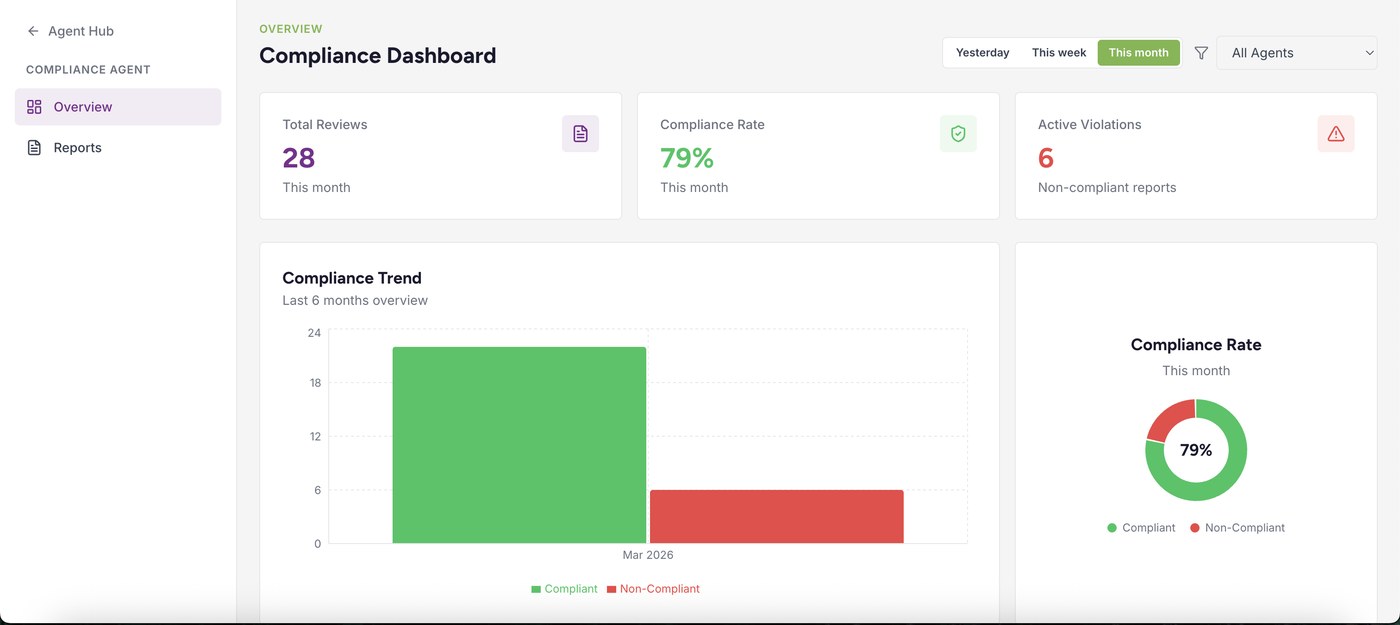
n8n Workflow Automation
View case study →Related reading
AI glossary
The AI and automation terms you'll actually run into as an Australian business owner (agents, LLMs, RAG, integrations), each explained in plain English.
BlogWhat is an AI automation agency
An AI automation agency builds working systems that run your business processes for you. What one actually does, and when you need one at all.
How-toHow to automate business processes
Five steps to automate a business process properly: pick the right one, map it, build it to production standard, and keep it running after launch.